Empathy at Scale
Our patent-pending AI solution is a SaaS offering that uses operational data from your business to predict an emotional well-being profile of every employee and their likelihood of burnout.

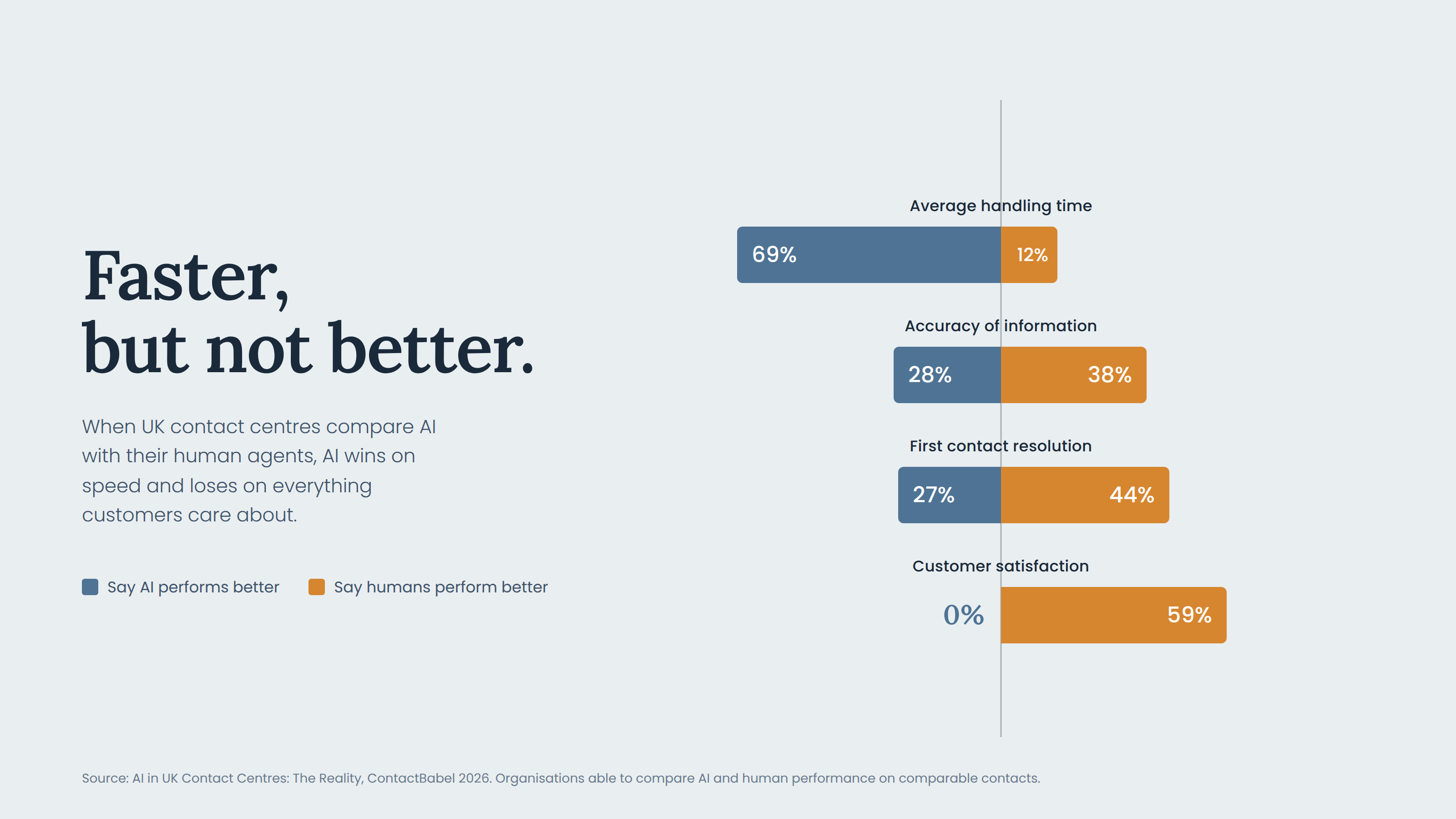
Faster, but not better
Where organisations have compared AI with human agents, AI wins on handling time and loses nearly everywhere else. Humans lead on accuracy and first contact resolution, and customers are even harsher: 69% say AI understands their issue worse than a person does. Even on speed, only 42% of customers say AI is faster, because they count the failed attempt, the queue and the re-explanation.
What's inside the report
Four gaps run through the findings:
The claim gap. How far self-reported AI adoption, including "agentic" AI, sits from what bots can actually do unaided.
The accountability gap. IT and finance hold the budget, but the contact centre carries the blame when AI gets it wrong.
The measurement gap. Between 36% and 47% of AI users can't say whether it outperforms a human on core metrics, often years into deployment.
The reality gap. Business data, customer data and failure data all point to the same weakness: accuracy.
You'll also get findings on budgets, bot resolution rates, escalation to humans, agent assistance, analytics, sourcing decisions and the outlook for the next two to three years.
The workforce story nobody is announcing
AI isn't cutting contact centre jobs through redundancy. It's doing it quietly. 41% of UK contact centres have seen headcount reduced or held down by AI, but only a small fraction came from redundancies. Leavers aren't replaced and vacancies stay open.
Meanwhile, the work left for agents is harder. The bot takes the simple contacts, and agents get a steady stream of complex, emotional, high-stakes conversations with no recovery time in between. 61% of leaders believe their agents are worried about their jobs, yet fewer than half consulted them before deploying AI, and not one organisation changed pay, grading or job titles.
That's where burnout, absence and attrition start, and it's usually your most experienced people who leave first.
Agentic AI for the human side of the operation
Anthrolytics is a Predictive Behavioural Analytics platform that forecasts burnout, absence and attrition 30 to 90 days ahead, then plans the response: who to talk to, when, and about what. It works on operational data you already have, with no surveys, no invasive monitoring and no PII required.

What You'll Learn:
Schedule a demo, or get moe information. We can also calculate your ROI. Let us know how we can help solve your burnout problem.